How a Bengali Professor is changing research on fungi?
The laboratory
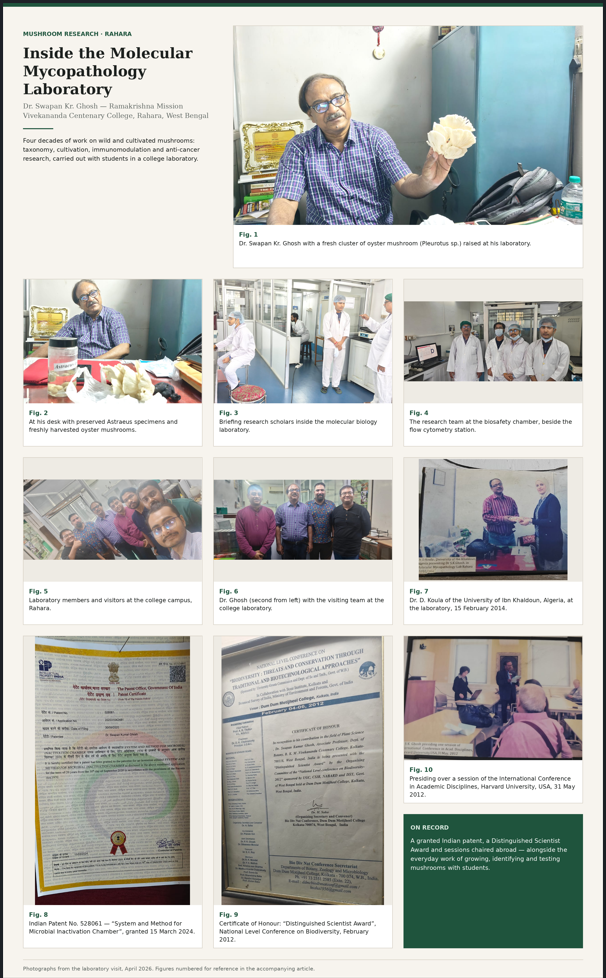
Tucked away within the verdant campus of Ramakrishna Mission Vivekananda Centenary College in Rahara, Dr. Swapan Kumar Ghosh's mycology lab operates with quiet discipline. Glass petri dishes, incubators humming at calibrated temperatures, and rows of test tubes contain hundreds of fungal strains gathered across decades of field expeditions.
Rather than chasing off-the-shelf commercial enzymes, Ghosh's team probes the molecular defense mechanisms of endophytes—fungi that live symbiotically inside plants without causing disease. Here, fundamental botany meets applied pharmacology at a fraction of standard institutional budgets.
The backyard
Much of Ghosh's most promising material was not sourced from deep rainforests or expensive repositories, but from ordinary backyards, roadside groves, and paddy bunds across the Gangetic delta. Indigenous flora, often dismissed as common weeds, harbor resilient microbial strains that produce potent chemical defenses against competing pathogens.
By systematically screening these localized fungal isolates, Ghosh has mapped an extraordinarily rich chemical library of natural alkaloids, peptides, and polyphenols tuned by centuries of ecological adaptation.
“Bishe bishakkhoy. You have to kill the enemy with the enemy.”
— Dr. Swapan Kumar Ghosh
Bishe bishakkhoy
The ancient Bengali adage—using poison to neutralize poison—forms the core philosophical and scientific anchor of Ghosh's work. In biological terms, fungal toxins that naturally suppress rival microbial life are harnessed and refined to target malignant cellular growth and resistant agricultural blights.
In vitro assays conducted in the Rahara facility show that specific secondary metabolites isolated from endophytic strains selectively trigger apoptotic cell death in selected cancer cell lines while leaving healthy control lines largely unharmed.
What has not happened
Despite landmark discoveries, the journey from petri dish to clinical bedside remains fraught with systemic inertia. While academic papers accumulate citations, the capital-intensive infrastructure required for rigorous in-vivo mammalian trials, pharmacokinetic modeling, and standardized pilot bioreactors remains out of reach for non-metropolitan state college laboratories.
Without substantial translational grants or private pharmaceutical partnerships willing to invest in long-horizon pre-clinical pipelines, groundbreaking discoveries risk remaining confined to academic journals.
Two patents two refusals
Ghosh holds two significant patents on fungal extraction protocols and biological formulations. Yet, early offers for outright technology transfer from overseas conglomerates were met with polite refusals.
Ghosh's insistence that the downstream applications, whether in crop bio-protection or low-cost therapeutic intermediates, remain accessible and affordable to domestic farmers and patients prevented typical quick-exit licensing deals.
“Science has to be for ordinary people. Otherwise this huge laboratory has no meaning.”
— Dr. Swapan Kumar Ghosh
The chain system
To keep the research pipeline resilient, Ghosh created an apprentice chain system. Undergraduate and postgraduate scholars at Rahara are trained directly in microbial taxonomy, gene sequencing protocols, and chromatographic purification.
Each student passes their isolation strains and bench notes down to the next cohort, creating an unbroken continuity of living culture collections that span over two decades.
Dr. Ananda Mohan Chakrabarty
Ghosh's work draws intellectual lineage from the late Dr. Ananda Mohan Chakrabarty—the legendary microbiologist who won the landmark US Supreme Court patent case for genetically engineered oil-eating bacteria and later discovered bacterial proteins with anti-cancer activity.
Chakrabarty had personally encouraged Ghosh to delve into fungal bio-agents, noting that fungi possess metabolic synthesis networks far more complex and adaptable than single-celled bacteria.
Explore the Peer-Reviewed Corpus
Review extensive citations, endophytic strain profiles, and published bio-assays across global indices.
At a glance
| Dimension | Details |
|---|---|
| Name | Dr. Swapan Kumar Ghosh |
| Position | Professor & Lead Mycologist |
| Institution | Ramakrishna Mission Vivekananda Centenary College, Rahara |
| Home district | North 24 Parganas, West Bengal |
| Doctorate | Molecular Mycology & Plant Pathology |
| Post-doctoral work | Bioactive Secondary Metabolites & Fungal Therapeutics |
| Research areas | Endophytic fungi, agricultural biocontrol agents, novel mycological anti-cancer compounds |
| Patents | 2 Granted / Applied Indigenous Process Patents |
| Output | 85+ Peer-reviewed international publications |
| Awaiting funding | Clinical validation & scaled bioreactor translation pipeline |